Cart
0
You might also like



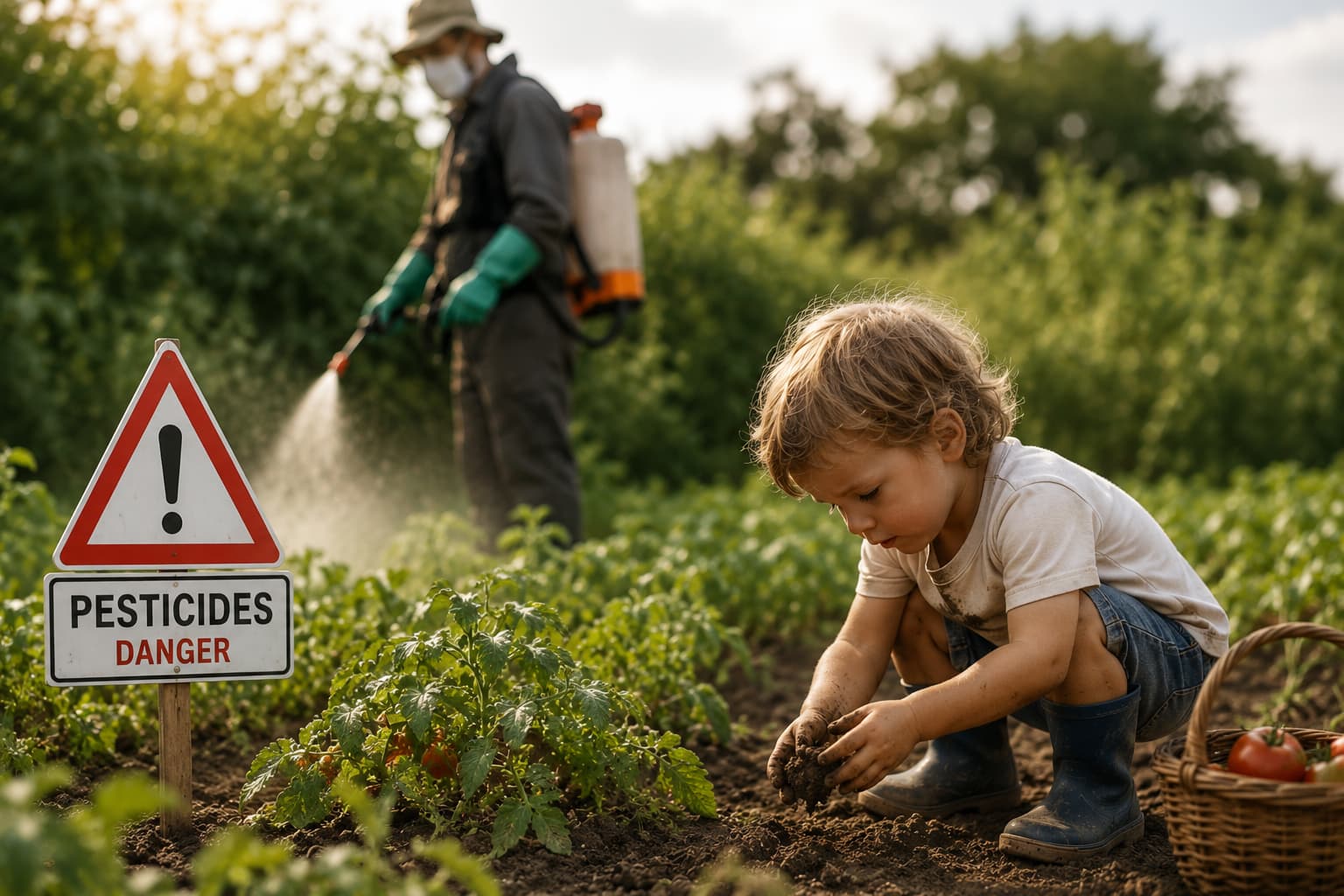
We wash them, peel them, and prepare balanced meals for them. And yet, every day, our children ingest traces of pesticides in their fruits and vegetables — without us knowing. These chemical residues, invisible and odorless, can have effects on their development that science is only beginning to measure.
In this article, we review what studies say, why children are particularly vulnerable, and how parents can take concrete action to reduce this exposure.
This is not a matter of emotional sensitivity — it is a biological reality. Children are not "small adults" when it comes to chemical substances. Their bodies react differently, and often more severely.
A child weighing 22 lbs (10 kg) consumes proportionally far more fruits and vegetables than an adult weighing 154 lbs (70 kg). The dose of pesticides ingested per kilogram of body weight is therefore much higher in children.
The liver — responsible for filtering and eliminating toxic substances — is not yet fully developed before the age of 2. Even into adolescence, children's ability to metabolize certain pesticides remains lower than that of adults.
The first years of life are a critical period for neurological development. Certain pesticides — particularly organophosphates — are neurotoxins that can interfere with this development during the most sensitive windows.
A child exposed from an early age accumulates residues over a longer lifetime. The long-term effects are therefore potentially greater than for an adult exposed later in life.
Research on the effects of pesticides in children has grown considerably over the past 20 years. The findings are concerning.
Several large-scale epidemiological studies have established a link between prenatal and postnatal exposure to organophosphate pesticides and:
A study published in Environmental Health Perspectives followed 329 children for 7 years and found that those whose mothers had the highest levels of organophosphate exposure during pregnancy had an average IQ 7 points lower.
Some pesticides act as endocrine disruptors — they mimic or block natural hormones. In children, this can affect:
The International Agency for Research on Cancer (IARC) has classified several pesticides as probable or possible carcinogens. Studies have established associations between childhood pesticide exposure and an increased risk of leukemia and brain tumors.
Some fruits and vegetables that children love are among the most contaminated. Here are the foods that deserve special attention:
Many parents think they are doing the right thing by rinsing fruits under water before giving them to their children. It is a good habit — but largely insufficient.
Here is why:
Pesticides are not all on the surface. Some are incorporated into the natural or artificial wax coating on fruits. Others are systemic, meaning they were absorbed by the plant itself and are found within the fruit's tissues.
Water does not dissolve fat-soluble substances. Fat-soluble pesticides — common among the most widely used — do not dissolve in water. They require a chemical or electrochemical action to be broken down.
Peeling helps, but is not always enough. For thin-skinned fruits like strawberries or grapes, peeling is impossible. And even for apples, residues can penetrate into the flesh.
The organic label prohibits (in theory) the use of synthetic pesticides. Prioritize organic for strawberries, apples, grapes, and peaches — the fruits your children eat most often.
This is today the most effective method for families who cannot buy everything organic. The KSD Cleaner GFC11 generates hypochlorous acid through water electrolysis — a molecule that breaks down the chemical bonds of pesticides without leaving any residue on food.
In just 5 to 10 minutes, it deep-cleans fruits and vegetables, meats, and seafood — even the strawberries and grapes your children love.
Do not give the same fruits every day. Variety reduces the risk of accumulating the same pesticide in the body.
Cooking breaks down some heat-sensitive pesticides. It is not a universal solution, but it is an additional reduction factor.
Organic products can contain permitted natural pesticides, or may have been contaminated by neighboring conventional crops. Rinsing remains an essential basic step.
For parents who want to take action without complicating their lives, the KSD Cleaner GFC11 is a practical and effective solution:
Feeding your children well also means making sure what they eat is truly clean.
Pesticides are not an abstract threat. They are present in our children's meals every day — in the fruits they snack on after school and the vegetables they eat at dinner. And their developing bodies make them particularly vulnerable to long-term effects.
The good news: simple actions can significantly reduce this exposure. Choosing organic for the most contaminated fruits, varying their diet, and above all cleaning food effectively with the right tool like the KSD Cleaner.
Because protecting your children's health starts in your kitchen.
→ Discover the KSD Cleaner and give your family truly clean food.

