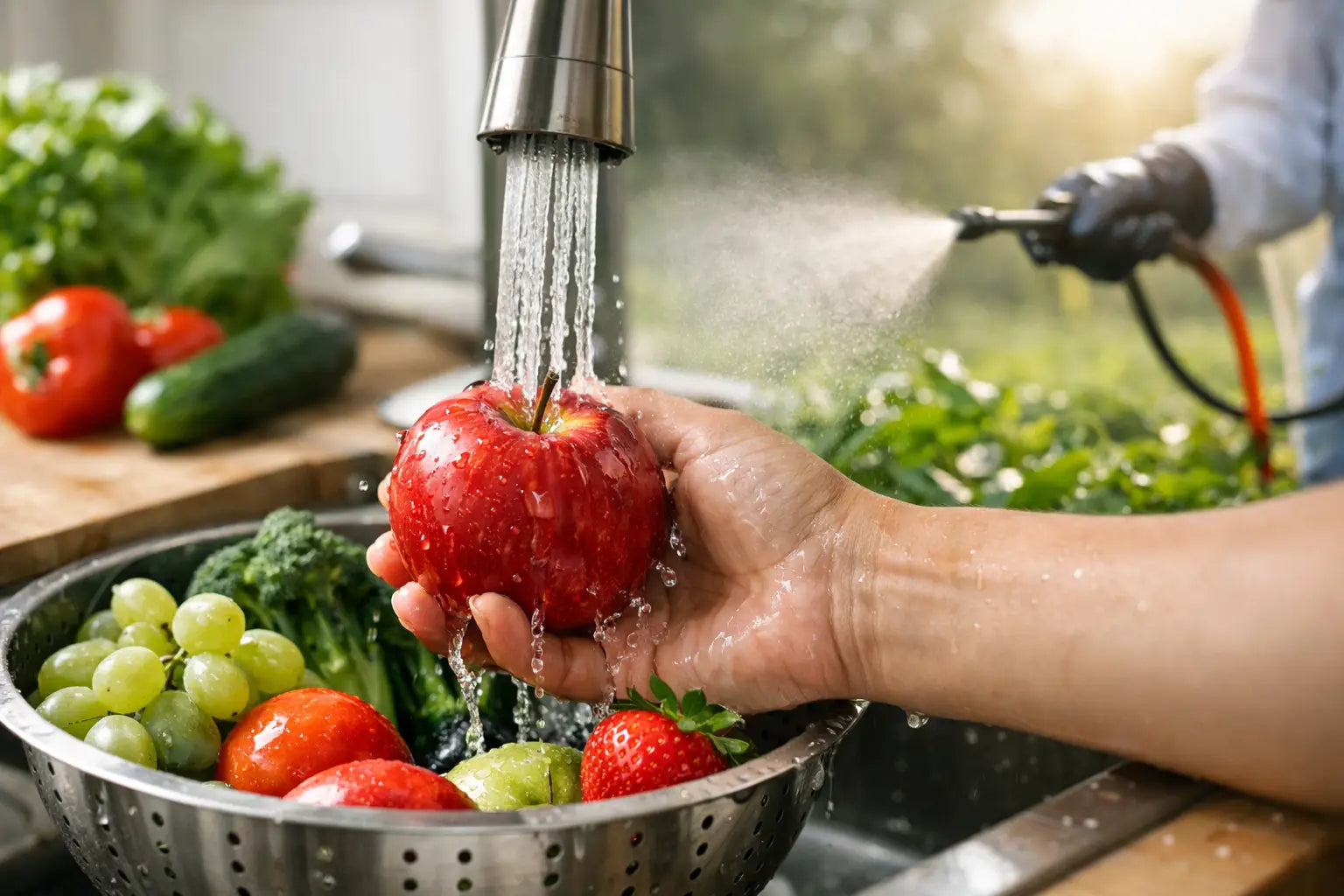
You bring home fresh strawberries, apples, and spinach because you want better meals on the table - not extra chemicals with them. So it is fair to ask: can pesticide residue be washed off? The short answer is yes, some of it can. But plain rinsing does not remove everything, and the amount left behind depends on the produce, the type of pesticide, and how thoroughly you clean it.
Can pesticide residue be washed off with water alone?
Water helps, and that matters. A good rinse under running water can reduce surface dirt, bacteria, and some pesticide residue sitting on the outside of fruits and vegetables. For produce with smooth skins, like apples, cucumbers, or grapes, friction from rubbing while rinsing can improve the result.
But water has limits. Many pesticides are designed to stay on crops through rain, humidity, and handling. Some remain on the surface in waxy layers. Others can settle into tiny creases, pores, or textured skins where a quick rinse does very little. Leafy greens are another challenge because residue can cling between layers.
That is why the answer is not simply yes or no. Washing helps reduce exposure, but it does not guarantee that produce is fully free of pesticide residue.
Why some residue stays behind
Not all pesticides behave the same way. Some are contact pesticides, which mostly remain on the outside of the produce. These are generally easier to reduce with washing. Others are systemic, meaning the plant absorbs them as it grows. If a substance is inside the fruit or vegetable, surface washing will not fully remove it.
Texture also changes the outcome. A smooth tomato is easier to clean than broccoli florets or a head of lettuce. Thin-skinned berries can be delicate, so people often rinse them lightly and move on. Unfortunately, that means more residue may stay behind compared with firmer produce that can handle more thorough washing.
Timing matters too. Residue can transfer during harvesting, packing, transport, and store handling. So even when pesticide levels are legally regulated, what ends up on your food is not just about the farm. It is also about the full path from field to kitchen.
What regular rinsing does well - and what it misses
A plain water rinse is still worth doing every time. It removes visible debris and can lower some surface-level residue. If you scrub produce gently with your hands or a soft brush, you improve contact and lift more from the skin.
Still, rinsing has a ceiling. It may not break down oily or wax-adhered residues very well. It may not reach the folds of kale, the tops of strawberries, or the rough exterior of peppers and melons as effectively as people assume. And if you only rinse for a few seconds, the reduction can be modest.
This is where many families get stuck. They are doing the right habit, but they are not getting the level of reassurance they want.
Can soaking help remove more pesticide residue?
In many cases, yes. Soaking gives water more time to loosen particles and residues from the surface. It can be especially useful for leafy greens, grapes, berries, and produce with irregular shapes. Agitation during soaking can make the process more effective because it helps dislodge what is clinging to the skin.
But soaking in plain water is still not a complete solution. Time alone does not guarantee better cleaning if the residue is stubborn, embedded in wax, or sitting in hard-to-reach areas. Soaking can also be inconvenient for busy households that want something fast, simple, and repeatable.
That trade-off matters. The healthiest routine is the one you will actually keep using.
What about vinegar, baking soda, or soap?
A lot of home methods get shared online, but they are not all equally practical or safe. Vinegar can help with some surface contamination, but it has a strong smell, may affect taste if not rinsed well, and is not a proven fix for every kind of pesticide residue. Baking soda is often recommended because it may help lift certain residues from the surface, especially during soaking, but it still has limits and adds extra prep.
Soap is not a good idea for produce. Fruits and vegetables are porous, and soap residue is not something you want to eat. Most food safety guidance advises against using household soaps or detergents on fresh produce.
So while DIY methods can offer some improvement, they are often inconsistent. They depend on the produce, the residue, the soaking time, and how much effort you are willing to add before every meal.
A more effective approach to produce cleaning
If your goal is simply to rinse off visible dirt, tap water may be enough. If your goal is stronger protection from pesticide residue and a cleaner feeling overall, you may want a method designed to do more than basic washing.
That is where food-cleaning technology makes sense for modern households. Instead of guessing whether a quick rinse was enough, a dedicated cleaning device gives you a more consistent process. It is built for the real concern many people have at home: not just whether produce looks clean, but whether it feels safer to serve.
For families trying to reduce daily exposure where they can, this is less about perfection and more about stacking the odds in your favor. Cleaner produce. Less uncertainty. More confidence at mealtime.
Can pesticide residue be washed off completely?
Completely is a strong word, and in most real kitchens, it is not the right expectation. Some residue can be reduced substantially. Some may remain. If the pesticide has been absorbed into the produce, no surface wash will fully solve that.
This is why peeling is sometimes suggested for certain fruits and vegetables. Peeling can remove residue on the outer layer, but it also removes fiber and nutrients concentrated in or near the skin. For foods like apples, cucumbers, or potatoes, that trade-off may or may not feel worth it depending on your priorities.
Buying organic can also lower exposure for some shoppers, but organic does not always mean residue-free, and it does not address bacteria, dirt, or handling-related contamination. Plus, organic options are not always available, affordable, or convenient.
For most households, the practical answer is layered protection. Choose produce carefully, wash it well, and use a better cleaning method if peace of mind matters to you.
What this means for families shopping every week
If you are filling your cart with produce for kids, meal prep, or everyday cooking, this question is not academic. It is about what lands on your cutting board tonight. You want healthy food to feel as clean as it looks.
That is why relying on a fast splash of water often feels incomplete. People want something simple, but they also want results. They do not want a complicated kitchen routine or a science experiment before lunch. They want a smarter way to clean food without adding stress.
A solution like the KSD Cleaner fits that reality because it is built around convenience and peace of mind. It helps turn produce cleaning into a quick, repeatable habit rather than an afterthought.
The better question to ask at home
Instead of asking only can pesticide residue be washed off, it helps to ask: how much can I realistically reduce, and how confident do I want to feel about the food I serve? That shift matters because it leads to better daily choices.
Water alone is better than nothing. Thorough cleaning is better than a quick rinse. And when you want stronger support for your household, a purpose-built produce cleaner can make healthy eating feel more protected and more practical.
Fresh food should come with confidence, not second-guessing. If a better cleaning routine helps you feel safer serving fruit, vegetables, and everyday meals, that is a small step that can make a real difference over time.